Music has always held a special place in my life. Back in 2012, while exploring the craft behind record production, I started noticing connections between that field and graphic design. In both, systems and constraints become a language for creativity.
That led me to explore whether musical patterns could be translated into geometric posters. What began as a personal experiment grew into the interactive collections I get to share with you today.
I grew up in Brasília, a city planned and built around a modernist vision by Lúcio Costa and Oscar Niemeyer. At the time, it was simply home. Still, that legacy stayed with me and later found its way into my work.
The relationship between art and design became clearer to me during college, when students from both disciplines shared the same spaces, and would debate the boundaries between the two. I still remember a sign someone put up in the hallway that read, “Save an artist from becoming a designer.” It made me laugh.
The two fields are distinct, but often sit close together. Minimal Theory lives somewhere in that shared space, an open framework with room for expression and interpretation.
Thank you for being here. This project is part of my journey as a designer. I hope you enjoy exploring it alongside me and creating something of your own.
— Bruno Perotto
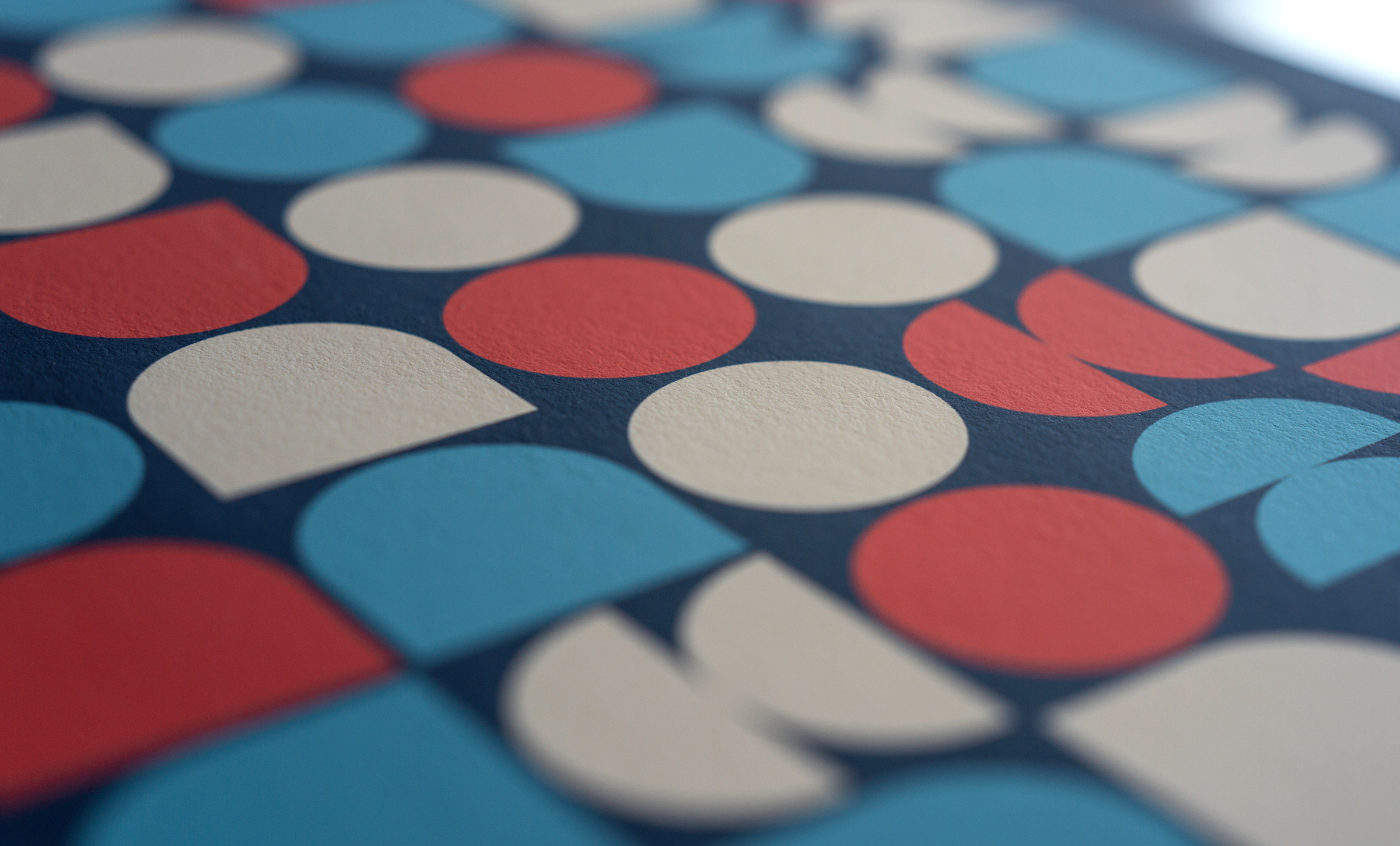
Fine art quality. Each piece is printed to order using archival Giclée printing with premium pigment inks on 310 gsm Hahnemühle fine art paper, and reviewed before shipping. The acid-free, museum-grade surface has a soft, lightly textured matte finish and is designed to preserve the artwork over time.
Each collection uses predefined color palettes that were carefully selected as part of the art direction. I’ve reviewed multiple prints to refine the palettes and make sure the colors work well on paper, not only on screen. Please note that colors may vary slightly depending on your monitor or device settings.
Prints are available in 8×12, 12×18, and 16×24 inches. Compare print sizes.
Not at the moment. Prints are sold unframed, and all three available sizes use a 2:3 ratio, compatible with many ready-made frames.
Prints are carefully packaged flat or rolled, depending on print size.
Yes. Shipping is free within the United States, including Alaska, Hawaii, and U.S. territories. International orders ship at a flat rate of $18, and every available destination appears in the country list at checkout. Orders ship from San Francisco, California.
Each print is made to order and usually ships within 3 to 4 business days. Delivery takes an additional 3 to 10 business days within the United States and 7 to 21 business days internationally. The estimate for your address is shown at checkout.
If your order arrives damaged or incorrect, just send a photo to hello@mnmltheory.com within 30 days of delivery, and I’ll take care of it with a replacement or refund as appropriate. If you’d like to cancel an order, please reach out within 24 hours of placing it.
Secure payments are handled through Stripe, with major credit cards and other payment methods accepted.
No. You can explore collections, create compositions, and save recipes without creating an account. Minimal Theory does not store your designs or personal information while you use the Create page's editor.
A collection is a visual system built around a specific design idea. Each one has its own rules, controls, color palettes, and art direction. As you adjust the settings, you can create different compositions while staying within that visual language. You can browse and learn more about collections on the Create page.
A recipe is a compact code you can generate on the Create page when you want to save a composition. Since Minimal Theory does not require an account, recipes let you restore or share the exact settings behind your design.
No. Every collection in Minimal Theory is designed by me. The shapes, color palettes, and visual systems come from my own design practice. AI tools have assisted with parts of the coding process, but they are not used to generate the artwork. Some collections include controlled randomness as part of the art direction.
